FTSE Finish Line: August 6 — Early Gains Fade as Earnings Fireworks Fail to Sustain Record Momentum
FTSE Finish Line: August 6 — Early Gains Fade as Earnings Fireworks Fail to Sustain Record Momentum
London’s FTSE 100 initially advanced on Thursday and looked set for a third straight session of gains, but optimism faded into the close as investors digested a heavy slate of corporate earnings. The benchmark finished broadly flat after earlier strength, with sharp rallies in WPP, Diageo, Serco and Persimmon offset by weakness in travel, property, data, investment trusts and selected cyclicals.
The early tone was constructive. Investors remained encouraged by optimism around U.S.-Iran talks and the possible reopening of the Strait of Hormuz, a development that would reduce the risk of a prolonged disruption to global energy flows. That theme has been central to market sentiment this week, helping global equities and supporting risk appetite, even as it creates mixed implications for UK sectors.
A reopening of Hormuz would be positive for inflation expectations, transport costs and household energy pressure. It would also support the Bank of England’s view that domestic disinflation can offset external energy shocks, allowing Bank Rate to remain on hold at 3.75%. But it can also reduce the geopolitical premium in energy and commodity names, making sector leadership more unstable. Thursday’s flat close reflected that mixed backdrop.
The standout move came from WPP, whose shares skyrocketed 25% after the world’s largest advertising group reported better-than-expected first-half profits and margins. First-half profit before tax rose to £106 million from £98 million a year earlier. Reported EPS fell 57.5% to 1.7 pence from 4.0 pence, but investors focused on the margin performance and the fact that results were better than feared.
WPP’s rally was important because the stock has been under pressure from concerns about advertising demand, technology disruption and client spending caution. A 25% move suggests the market had been positioned for a much weaker update. When a heavily discounted stock delivers even modestly better news on margins and profit, the rebound can be powerful.
Diageo was another major gainer, jumping 7.5% after announcing a plan to save $1 billion over three years following a 27.2% fall in first-half operating profit. The headline profit decline was weak, but investors welcomed management’s cost-savings plan as a credible response to pressure on margins and demand. As with WPP, the share-price reaction showed that expectations had already been low.
The Diageo move also gave support to consumer staples after recent mixed trading across beverages and defensive names. Investors are looking for evidence that large consumer companies can protect margins as pricing power normalises and volume growth becomes more important. A clear cost plan helped offset concerns about the near-term earnings decline.
Persimmon advanced 3.5% after saying it expects annual home deliveries to be at the top of its prior forecast range. The update continued the recent positive tone around housebuilders, which have benefited from falling yields, lower oil-price inflation risk and hopes that the BoE will remain on hold rather than restart tightening. Better delivery expectations added a company-specific catalyst to the rate-sensitive housing trade.
Serco soared nearly 7% after reporting higher first-half underlying profit and increasing the size of its share buyback programme. The update fit the market’s recent preference for companies combining earnings resilience with capital returns. Buybacks have been a recurring support across UK equities this earnings season, from banks to outsourcing and industrial names.
Admiral gained nearly 6%, while Vodafone, BAE Systems, Weir, Spirax, Prudential, NatWest, IMI, HSBC, Babcock, Haleon, Hiscox, Centrica, Airtel Africa, Antofagasta and Aviva rose between 1% and 2.5%. The breadth of those gainers showed that investors were still willing to buy into stock-specific strength, defensives, financials, defence and selected industrials.
Defence names remained supported despite improved hopes around Hormuz. BAE Systems and Babcock both gained, underlining that markets still view geopolitical risk as persistent even if the immediate energy chokepoint concern eases. The U.S.-Iran talks may reduce the probability of near-term supply disruption, but they do not erase the broader security premium.
Financials also held up relatively well. NatWest, HSBC, Prudential, Hiscox and Aviva gained as investors continued to reward capital strength, earnings visibility and shareholder returns. The sector has had a selective but generally constructive earnings season, with NatWest, Lloyds and Standard Chartered all previously benefiting from profit beats, outlook upgrades or buybacks.
Tullow Oil was volatile. The West Africa-focused oil and gas explorer plunged earlier on concerns over unchanged debt levels, but later recovered most of the decline and was down only about 1%. The move showed that balance-sheet concerns remain acute for smaller energy companies, especially when oil prices are being influenced by rapidly shifting geopolitical expectations.
On the downside, Wizz Air dropped 4.3% after reporting a bigger-than-expected quarterly net loss. The airline remains exposed to fuel costs, operational disruption, competitive pricing and consumer demand uncertainty. Even if Hormuz optimism lowers crude-price risk, investors still need evidence that carriers can convert demand into profits.
Tritax Big Box REIT fell 3.4%, while RELX shed 2.7%. Polar Capital Technology Trust, St. James’s Place, Segro, Glencore, Tesco, Smith & Nephew, Schroders, 3i Group, Scottish Mortgage, Entain and Melrose lost between 1% and 2%. The weakness in property and investment vehicles suggested some caution toward duration-sensitive or previously strong areas, while Glencore’s decline reflected a pause in the mining rally.
RELX’s fall looked like profit-taking or reassessment after a strong recent run in high-quality data and analytics names. Tesco’s decline contrasted with Persimmon and Diageo’s gains, suggesting investors were becoming more selective within consumer-exposed stocks. Smith & Nephew remained under pressure after its earlier guidance downgrade tied to weaker U.S. demand for hip and knee implants.
The economic data added a cautiously better domestic signal. The S&P Global UK Construction PMI rose to 44.7 in July from 38.4 in June, extending the rebound from May’s six-year low of 38.2. The index remains below 50, meaning the sector is still contracting, but the pace of decline has eased materially.
That improvement matters for housebuilders, building materials and domestically sensitive names. A construction sector still in contraction is not a strong backdrop, but the rebound suggests conditions may be stabilising. Combined with lower yields and Persimmon’s better delivery outlook, the data helped support the housing-related recovery narrative.
For the Bank of England, the construction data are consistent with a cautious hold. Activity remains weak enough to argue against further tightening, while recent inflation indicators have been soft enough to support patience. The key risk remains whether energy shocks from the Middle East become embedded through wages and pricing behaviour. Hormuz reopening hopes reduce that risk, but do not remove it.
The broader market’s flat close also reflected positioning after a powerful July. The FTSE 100 hit repeated record highs last week and entered August with investors sitting on strong gains. In that context, even impressive individual earnings were not enough to keep the whole index moving higher. The market is still constructive, but it is becoming more demanding.
Finish Line: The FTSE 100’s early push for a third straight gain faded into a flat close as investors balanced Hormuz optimism with a crowded earnings calendar. WPP surged 25% after better-than-expected profits and margins, Diageo jumped 7.5% on a $1 billion cost-savings plan, Serco soared on higher profit and a larger buyback, and Persimmon rose after guiding deliveries to the top of its range. But Wizz Air fell on a wider-than-expected loss, RELX and Tritax weakened, and several investment and property-linked names slipped. UK construction PMI improved to 44.7, still contracting but far better than May’s six-year low. The market’s message was selective: earnings beats and credible self-help plans are being rewarded sharply, but after July’s record run, broad index upside is harder to sustain..
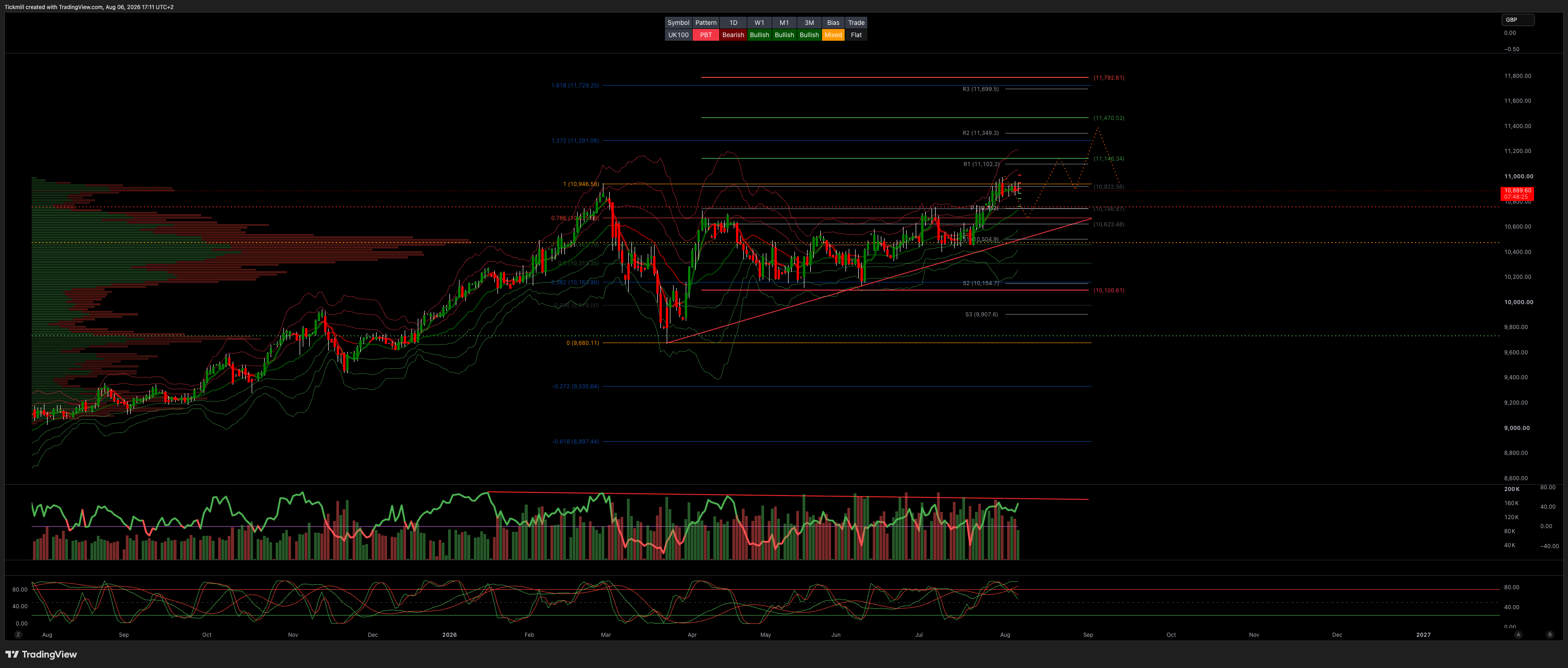
TECHNICAL & TRADE VIEW – FTSE100
Daily VWAP Bullish
Weekly VWAP Bullish
Above 10700 Target 11150
Below 10400 Target 9500
Disclaimer: The material provided is for information purposes only and should not be considered as investment advice. The views, information, or opinions expressed in the text belong solely to the author, and not to the author’s employer, organization, committee or other group or individual or company.
Past performance is not indicative of future results.
High Risk Warning: CFDs are complex instruments and come with a high risk of losing money rapidly due to leverage. 69% and 73% of retail investor accounts lose money when trading CFDs with Tickmill UK Ltd and Tickmill Europe Ltd respectively. You should consider whether you understand how CFDs work and whether you can afford to take the high risk of losing your money.
Futures and Options: Trading futures and options on margin carries a high degree of risk and may result in losses exceeding your initial investment. These products are not suitable for all investors. Ensure you fully understand the risks and take appropriate care to manage your risk.
Patrick has been involved in the financial markets for well over a decade as a self-educated professional trader and money manager. Flitting between the roles of market commentator, analyst and mentor, Patrick has improved the technical skills and psychological stance of literally hundreds of traders – coaching them to become savvy market operators!